The place
Santo Stefano al Ponte: the old church beside the Ponte Vecchio
A church recorded in 1116, a striped marble portal and a long second life as an auditorium: what the sources say about the building.
Reserve my seats ↗Quick answer
Santo Stefano al Ponte is a Romanesque church close to the Ponte Vecchio, documented in 1116 and probably founded earlier. Italian Wikipedia describes a lower facade with Romanesque traces and a portal framed in white and green marble, a Baroque remodelling of the interior in the 17th century and a modern career as an auditorium and exhibition space. The concert page names it, as the Santo Stefano al Ponte Vecchio auditorium, as one of two possible settings; the Zeffirelli Museum is the other, depending on the option booked.
The church in brief
| Santo Stefano al Ponte | |
|---|---|
| First record | 1116, in the earliest known list of Florentine churches |
| Medieval form | A single nave and Romanesque facade traces, shaped in the 13th and 14th centuries |
| Portal | White marble framed with green marble from Prato, says Italian Wikipedia |
| Remodelling | The interior reworked between 1631 and 1641, finished in 1655 |
| Later use | Auditorium, exhibitions and concerts in recent decades |
A very old site by a very old bridge
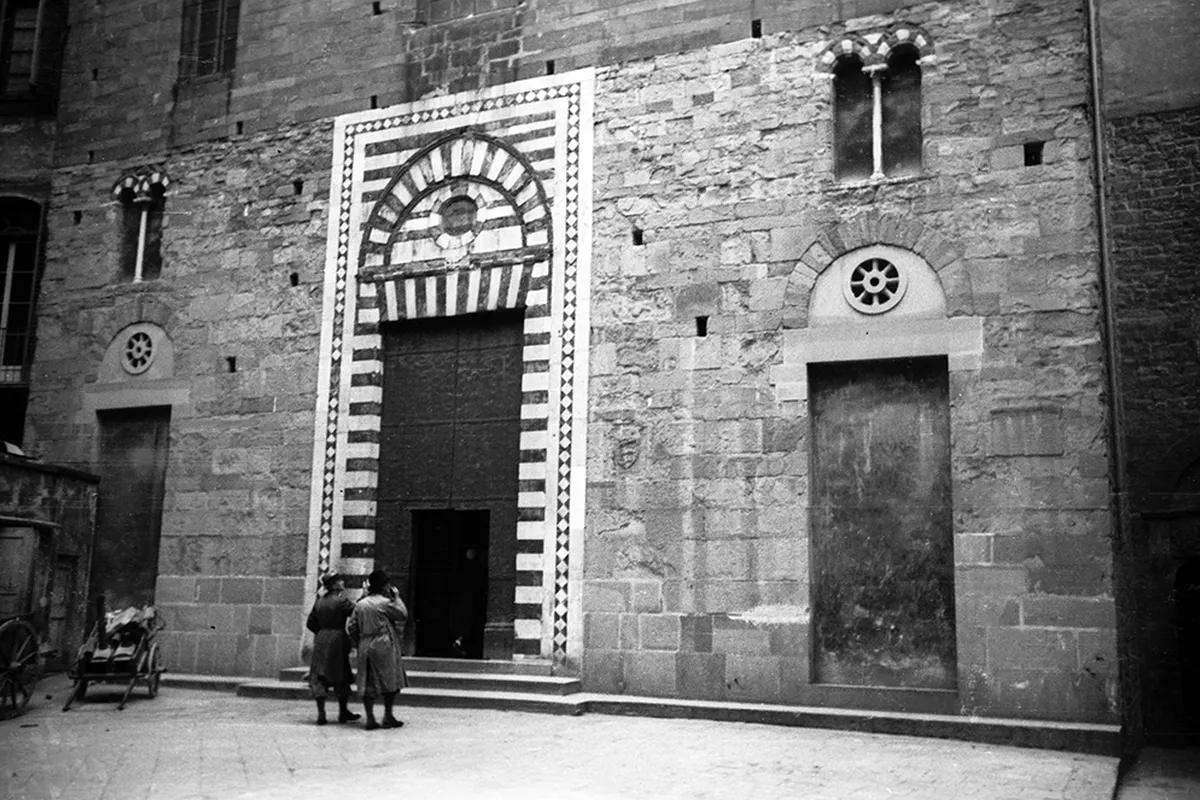
The church stands near the Ponte Vecchio, in the part of the centre that runs from the river up towards Palazzo Vecchio. Italian Wikipedia says it appears in 1116 in the earliest known list of Florentine churches, and adds that it was probably founded much earlier; local legend even links it to the time of Charlemagne, which the page presents as legend. Documentation from the early twelfth century makes it one of the older religious buildings in this area, and its position beside the river crossing is unlikely to be an accident, since medieval churches often gathered near the places where people passed.
The medieval building and its portal
The page reports that between the thirteenth and fourteenth centuries the church took its present form: a single, longer and wider nave, three chapels around the choir and a roof with exposed timber trusses. The portal is dated to about 1233. It is framed in white marble and a green marble from Prato, a striped scheme familiar from Tuscan Romanesque buildings. The upper part of the facade belongs to a slightly later span, between the thirteenth century and the early fourteenth. If you visit the street outside, the portal is the part that most clearly reads as medieval.
The Baroque interior
The Augustinians received the church in 1585, and from 1591 it was joined to the demolished church of San Pier Scheraggio. Between 1631 and 1641 the interior was remodelled, and the work was finished by the heirs of the sponsoring marquis in 1655. In 1783 the church took on the title of the demolished Santa Cecilia, and it was reconsecrated on 14 October 1787 as the priory of Saints Stefano and Cecilia. These dates matter because they explain why a Romanesque outside can hide a different, later interior, and why the church is more layered than its portal suggests.
Twentieth-century damage and recovery
Italian Wikipedia records that late nineteenth- and early twentieth-century restorations recovered Romanesque windows and a Gothic niche and brought a staircase by Buontalenti from the church of Santa Trinita. On 4 August 1944 retreating German troops destroyed buildings near the nearby via Por Santa Maria, and the page notes that a holy-water font on the facade was destroyed in 1944. The church was also heavily damaged by the flood of 1966. It reopened for worship on 31 October 1981, and in 1986 it was suppressed again during a reduction of parishes in the historic centre.
From parish church to concert hall
After its closure as a parish, the page says, the church served for some years as the auditorium of the Orchestra regionale toscana. It was seriously damaged after the bombing of via dei Georgofili on 27 May 1993 and was quickly restored. From 2015 it hosted interactive exhibitions, and from 2016 weekly concerts. That is the background to a booking page that calls it a historic church turned concert hall. For a listener, the useful consequence is acoustic and atmospheric: a stone nave built for a congregation's voices, now filled with the sound of strings.
What this means for your evening
If your option names the Santo Stefano al Ponte Vecchio auditorium, you are walking into a building with nine centuries of layers rather than a modern hall. The confirmation gives the entrance details and the start time, and this guide does not quote either. Allow a little time to look at the portal before you go in, and remember that the concert is only one of the page's possible settings: the other option places you in the Zeffirelli Museum instead, so check your own ticket first.
Frequently asked questions
Is the church open to visitors at other times?
This guide cannot say. The sources used here do not give visiting hours, and the concert ticket covers the concert only.
Is Santo Stefano al Ponte near the Ponte Vecchio?
Yes, the booking page calls it the Santo Stefano al Ponte Vecchio auditorium, and Italian Wikipedia places it near the bridge.
Will my concert be in this church?
Only if your option names it. The page lists a second setting, the Zeffirelli Museum, for other options.
Is the church from the 1100s?
It is documented in 1116 and probably older; the present form dates from the 13th and 14th centuries.
Sources